Archive for the ‘Plyometrics’ Category
Lunges to Improve Tennis Fitness
…and your overall fitness. Lunges are great exercise that will improve the strength of your entire lower body, balance, coordination, and your tennis fitness. You don’t need any equipment or gym to do your lunges, and to make it more entertaining, there is a variety of different versions of lunges. You will never get bored!
Split-step Lunges
Step a big step far back with your right leg, and sink low. Make sure that your left knee is above your left foot, with pressure toward the heel. Feel how your left glute is working. Keep your right foot pretty relaxed, pointing straight forward, heel lifted. Make sure not to twist it sideways, just because you feel like it will give you better balance. Keep your upper body erect and vertical, with your chest and chin up. Sink low, then push yourself up, feel the glutes working. Repeat 10-20 repetitions and then switch leg. You can have weight in your hands or on the shoulders.
Lunges Back
Just like in the previous version, you step back with your right leg, keep nice erect upper body, sink low, and then push yourself up to standing on your left leg. You can lift the right knee high up in the front, to add difficulty. Do all the repetitions on the same side and then switch legs, or alternate after each lunge.
Lunges Forward
Instead of stepping backward, you will step forward with your right leg, sink low (make sure your knee won’t pass the foot) and then connect with your glute and push yourself back to standing. To add difficulty, lift the right knee high up. Keep your posture erect at all times. Again, you can do all the repetitions on one side and then switch, or alternate between left and right.
Lunges Sideways
Just like stepping forward, you can step to the side, or 45 degrees to the left or right. Make sure to sink low by bending your leg, not your hip and losing your posture. Always stay nicely erect.
Walking Lunges
Step forward with your right leg like in the forward lunge and then instead of returning back to original position, you bring your back leg forward. To add difficulty, you can lift the left knee high up before you step forward. Lunge-walk forward for 20-30 repetitions.
Walking Lunges with Twist
Each time you step forward and sink low, twist your entire upper body to the side of the front leg. You can keep your arms in front of you for better stretch during the twist, or you can hold a medicine ball in front of you.
Walking Lunges with Kettlebell Over Head
You can use a dumbbell or any other weight. Kettlebells are just more intense because of the balance. Hold one kettlebell in one arm above your head. Keep your arm straight during the entire movement and keep doing 20-30 walking lunges forward while keeping the arm up. Pay attention how the muscles in your back are working to stabilize the weight over your head. On the way back, switch your arms. If you don’t have enough space for walking lunges, you can do front or backward lunges with the kettlebell over the head.
Jump Lunges
Get into a deep lunge position and instead of stepping back or forward to the start position, explode from both feet high up in the air, switch the legs in the air and land smoothly (like a big cat) down into a deep lunge again. This is intense and great for improving your explosiveness and tennis fitness.
In addition to endurance and strength, good tennis fitness requires a lot of explosive power. You need to have strong legs, hips and core to load, coil and uncoil into the shot. Kettlebells are excellent tool to train your hips, core, legs, shoulder stabilizers and endurance simultaneously. Performing the basic kettlebell swing will get your heart rate high up, almost as high as running 8-minute mile.
Basic Kettlebell Swing for Better Tennis Fitness
Before you start swinging, you need to find a kettlebell that is not too light for you. If it is too light, you may develop bad habits, such as using your arms too much and “muscling” the bell up and down. Yet, you don’t want to have the bell too heavy so you cannot develop a good technique. Women can start with 26 lbs and quickly transition to 35 lbs. Men can start with 35 lbs and transition to 45 lbs, or just do more repetitions. A basic swing with 35 pounder for 35 repetitions gets pretty tiring.
Make sure your chest and chin are always up. Focus your eyes on something far in front of you and don’t lose that thing from your focus during swinging. Keep your lower back neutral or slightly arched. Your stance is wide and the kettlebell hanging between your legs. Bend your knees slightly, push your glutes back and then with a powerful explosive movement of your hips forward (like you want to hit an imaginary wall with your hips), catapult the kettlebell upward. Your arms and hands should remain as relaxed as possible. Hold the bell loosely. Then let the bell descend with a free fall, don’t resist it with your arms. As it is going down, stick your glutes out and immediately explode into another powerful thrust.
Under no circumstances let your chest collapse or bend in your hips. Keep your posture always erect. If you do your hip snap correctly and powerfully, you will feel a little “shake” of everything on the front side of your body. That’s a good thing! Keep swinging until you develop smooth and effortless technique. You will feel how your glutes and hamstrings are working intensely. Your forearms and grip will get stronger as well.
If you handle the basic swing well, you can proceed to a one-handed swing, and you can switch the hands on the top of the movement (the kettlebell’s apex). This will teach you to have your hands relaxed, because if you grab the bell too tight, it is difficult to get the timing of switches right. As you proceed to more advanced stage, you can flip the kettlebell with underspin or overspin at the apex, with both hands or one hand.
In the following video, observe the nice erect posture, relaxed hands, and the power of the hips. A regular kettlebell swinging will improve your tennis fitness dramatically! Watch another video of a more advanced tennis fitness kettlebell swinging.
More articles on kettlebells for better tennis fitness
| Get your kettlebells and other fitness & injury prevention products at Power-systems.com. Good quality, good price... Use code C55018 to get a free shipping on purchases over $45, 40% off on selected items, until midnight December 1, 2011. |
In today’s tennis game the player’s fitness and conditioning are more and more important. For the player who strives for improvement, the off-court tennis fitness training should be as crucial as the tennis play itself, with the focus on strength, explosive power, balance, agility, coordination, endurance, and injury prevention. In tennis, the key element is great movement—if you move well, you get to the ball fast and on balance and your shots are going to be more powerful.
Strong and powerful legs are not just beautiful but also extremely useful in tennis. Bending your knees will achieve a low base, giving you better balance and better transfer of forces from the ground, through the kinetic chain and upward to your arm, racket and to the ball. As a result, your shots will be more powerful. However, to bend your legs deeply in each shot is highly energy demanding. The tennis players with better fitness and stronger legs will have an advantage.
Having a strong core is extremely important in tennis. It gives stability to your hips and shoulders, which are essential for your stroke production, and it permits a smooth transfer of power from the core to the limbs with perfect balance, strength, and flexibility. A strong core allows your limbs to move more efficiently and independently from each other, and as a result, you will run faster and still execute your shots with precision and power.
In this e-book you will learn how to train your legs, core and shoulder stabilizers efficiently. You don’t need any equipment, and all exercises can be done outdoors – on the tennis court or in the park. A few short routines are outlined as well, you can perform them after your tennis practice. For maximum performance, you should be stretching regularly and perform myofascial release with a foam ball for future injury prevention.
![]()
Content
1. Triangle Lift, aka Windmill
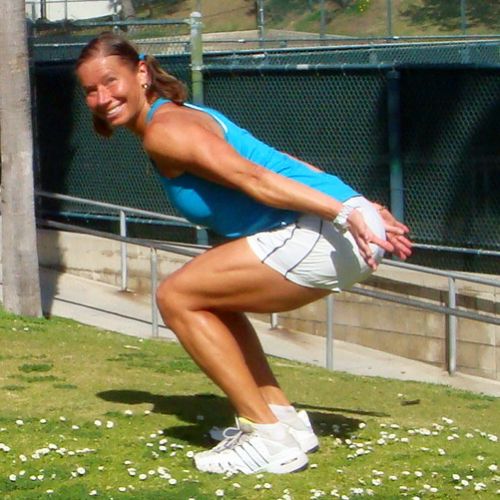
2. Walking Lunges
3. Jumping Lunges
4. Functional Crossover Lunges
5. Jump Squats
6. Jump Squats with Open Legs
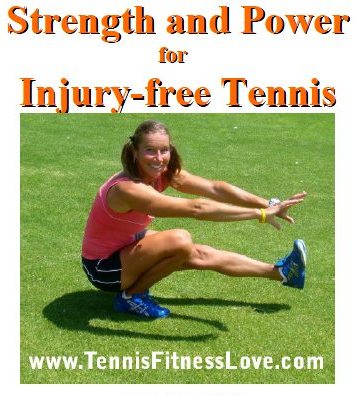
7. One-leg Squat: The Master Exercise
8. Glute Bridge
9. Hip Flexor Strengthening
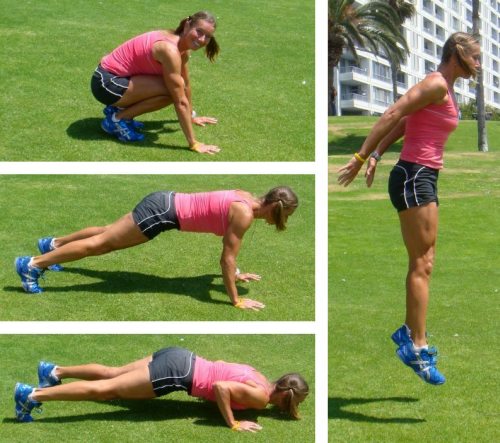
10. Burpee: The Ultimate Conditioning Exercise
11. Plank with Knee-To-Elbow Touch
12. Plank with Arm and Leg Lifts
13. Plank with Hip Twists
14. Side Plank with Leg Lifts
15. Upper Back Row with Resistance Band
16. Shoulder External Rotation with Resistance Band
17. Mini-Workout: Legs, Core, and Shoulders
18. Mini-Workout: Legs, Core, and Agility
19. Mini-Workout: Core and Upper Body Stabilizers
Price: $2.99
The legendary tennis coach Oscar Wegner (modern tennis methodology) has interviewed me about my book “Tennis Fitness for the Love of it.” We were chatting about the importance of fitness and stretching for maximum tennis performance and life. Watch, listen and enjoy!
You can find more of Oscar’s teachings at www.tennisteacher.com
To make sure that you are completely satisfied with your decision to buy “Tennis Fitness for the Love of it”, you can view sample material from the book in the resources below. Enjoy the viewing.
Amazon’s Search Inside Feature
Sample Chapter 13 — Calf Myofascial Relase
I am glad to announce, that the book “Tennis Fitness for the Love of it. A Mindful Approach to Fitness for Injury-free Tennis” that many have been so impatiently waiting for, is available on Amazon.com for $14.95. Get your copy here now! For bulk orders, please contact me.
To all the tennis players of any age and skill level, who always strive for improvement and who never stop believing that the impossible is possible, and who know that there are no limits to growth and performance other than the human mind.
It is Never Too Late to Become Functional, Fit and Healthy
It is possible to play pain-free tennis for the rest of your life. One of the prerequisites is improving your fitness. However, it is not just any fitness. It needs to be mindful, purposeful, and perfectly suited for you. Nobody can tell you what is perfectly suited for you, only your body can. Listen to it because it will ask for what it needs. In your pursuit for maximum fitness and tennis performance, you need to be aware, patient, and disciplined.
Carry this little book with you always and reread the chapters often. Each time you will discover something new. Learn to understand your body. Every exercise you do should be performed with the goal of increasing awareness of your body, and gradually building a new relationship with it. Learn how to free up the tightness and how to balance your strengths. The less pain you experience, the healthier and more functional you are, and the more your energy will increase. Treat the moments of stretching and myofascial release as time for meditation, relaxation, and introspection.
Create daily routines that fit your lifestyle and treat them as essential for your fitness, well-being, and tennis performance. Think of your health and fitness in the long term. Be patient and disciplined in applying the new ways of exercising and treating your body. Remember that even modest effort applied over the long term will bring excellent results. Therefore, do not postpone your fitness until tomorrow and start today, even if it is just a little bit. Treat your body with respect and love. Treat the fitness as one of the necessary elements of your tennis game. Become fit for tennis and you will become fit for life, and tennis will be in your life forever. Practice your tennis fitness, for the love of it.
To become a great tennis player doesn’t mean that you only play and practice tennis. You have to give at least the same amount of time and attention to your fitness. The better your tennis fitness, the more success you will have on the court. You want to have strong legs and core, good balance, coordination and explosive power. You might find it difficult to fit in all the fitness training on a top of playing tennis, and at the same time go to school or work. If you decide to devote yourself to fitness, you could start easy, but be persistent with it. Just a little workout after each tennis practice, maybe 20-30 minutes and another 10-20 minutes for stretching, and over a period of one week it adds on to 3-5 hours of tennis fitness training. Pretty amazing, isn’t it?
Leg strength, core strength, balance, coordination and flexibility – that’s what you need to work on to become sufficiently fit to play good tennis. Most of the players realize how important role the fitness plays in tennis, and they visit the gym on a regular basis. In Los Angeles where the weather is sunny almost the entire year, a tough grass or beach workout makes a nice change in your routines. Try this extremely effective 30 minute workout directly after your tennis practice. It will work your legs, core and foot work.
A fit tennis player wants to have a strong, flexible, explosive and well coordinated body with good stamina. If there’s one exercise that would achieve all this, it is a “Burpee”. It works most of the major muscle groups in the body and the cardiovascular system as well. It is used in military, martial arts and almost all sports as an excellent conditioning exercise. And especially in the hot conditions of Los Angeles, you want to become extremely fit. You are probably familiar with it because you have done it in the elementary school and maybe strongly dislike it to this day. Burpees are hard. They make your legs burn and your chest and shoulders ache, and they make you sweat and breath hard. But they are so good for you!
In tennis you need explosiveness, strength, balance, stamina, speed and agility. The movements you do on the tennis court are short and fast, so you are using a lot of anaerobic energy. But because you stay on the court for hours, you need a good aerobic endurance as well. Running stairs is a great activity that can give you tremendous results in your tennis fitness training. Running stairs is extremely effective in increasing your endurance and building your lower body strength. And if you want to add the balance and agility element into your stair training, you can do different variations of lunges and jumps, described below.