Archive for the ‘Myofascial Release’ Category
Every high level athlete is pushing his or her body to the extreme – training every day for hours and often on hard surfaces (the concrete courts of Los Angeles are very unfriendly to the tennis player’s body!). Additionally, the uneven nature of tennis where one side is always used more than the other, makes it even worse for your body. You need to spend as much time and effort – if not more – to recreating balance and health in your body as you do playing tennis. You need to 1) stretch after each practice, 2) pay good attention to your body and listen to its even subtle signs signaling you what is happening, and 3) be aware of your posture, balance, flexibility and “evenness” of your both sides – the right and left side of your body should be equally strong and flexible.
It is very common that tennis players have tight hamstrings. You use them when running and jumping on court as they are assisting to bend your knee and extend the hip. And if you are one of the few that stretch the hamstrings regularly, and despite all the stretching they still remain tight, you need to do myofascial release. When you finish your tennis practice, then you probably sit down, or drive in your car, or go to work and sit again. The sedentary life style and sitting for prolonged periods are detrimental for your hamstrings. They get short and stiff and form trigger points frequently. The trigger points prevent the hamstring muscles from lengthening and proper function. Hamstrings with trigger points don’t respond to stretching or warm-up well which increases the risk of strains, pulls or tears.
A tennis player’s calf muscles work extremely hard on the tennis court, especially the concrete courts of Los Angeles. To play good tennis you need to be light on your feet with the weight on your front foot most of the time. The constant small steps to adjust the body to the oncoming ball, pushing off, stopping and changing directions will make the calves work very hard. One of the major reasons of calf injuries is their poor conditioning. When your calves become inflexible and weak, they get easily overworked and overstretched. Tight calves develop trigger points and then even stretching will not help. You may experience other painful symptoms, such as shin splints, plantar fasciitis or sore Achilles tendons. To get rid of the trigger points you need to do myofascial release for your calves.
The hip flexor muscle, also known as iliopsoas, can cause severe pain if it gets tight. Its main function is to flex the thigh. The constant running and lunging on the tennis court can easily overwork the hip flexors. They get short and tight and very often will form trigger points. The hip flexors are actually two different muscles: the psoas runs on the sides of the lumbar spine to the hip, and iliacus that runs from each side of pelvis and joins the psoas at the hip. Trigger points in hip flexor refer pain into the low back, alongside the spine or across the back. It can be pretty excruciating – standing or lying down – and almost nothing can relieve it. Sometimes it is hard to get up, you might feel sciatica symptoms, and you can feel pain in the front of the thigh as well.
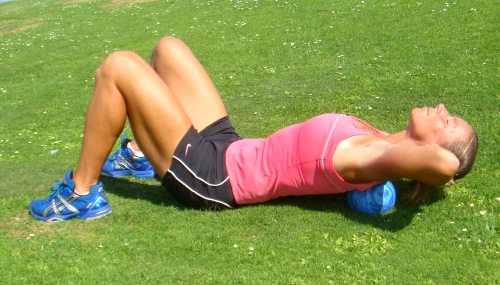
In the majority of the tennis strokes, you have to perform an upper body rotation, rotating and loading in your hips. But a lot of trunk rotation also comes from the thoratic (upper back) spine. Overuse and small micro tears cause the upper back muscles to tighten to protect themselves. If the upper back becomes weak and tight you can experience severe problems and pains. The tight muscles don’t allow as much blood into them, so there is not enough supply of nutrients and energy needed to stay healthy. Tight muscles eventually get weak and then tighten even more. That is a vicious circle that you need to break. If you don’t stretch properly, especially after your training or practice, the muscle never gets elongated to its natural length and over time will adapt and become short.
Chest muscles, or pectorals, are very often overused and shortened in a tennis player. They can become stiff from overtraining and cause shoulder problems, poor breathing and hunched back. Stretching of your chest muscle is important, but sometimes doesn’t do the job because it is difficult to reach deep. It is very common that trigger points form in the chest muscles. Trigger points in the fascia of the muscle can restrict and alter the motion of the joint, changing the feedback to the nervous system which becomes less efficient over time, and you can experience premature fatigue, chronic pain and injuries.
Pain in the hips and knees is a major source of distress for a serious tennis player. If you have aches in your hips or knees, you cannot move freely because every step will remind you of your discomfort. Common pain explanations are: arthritis, ligament injury or deterioration of joint cartilage. But very often the problem is not that serious. The pain can be nothing more than referred pain from trigger points in the muscles of the thigh. The pain can be so intense that it is very similar to a pain of a damaged joint. If you have a knee or hip pain your first step should be to look for trigger points and try to treat them yourself with self myofascial release.
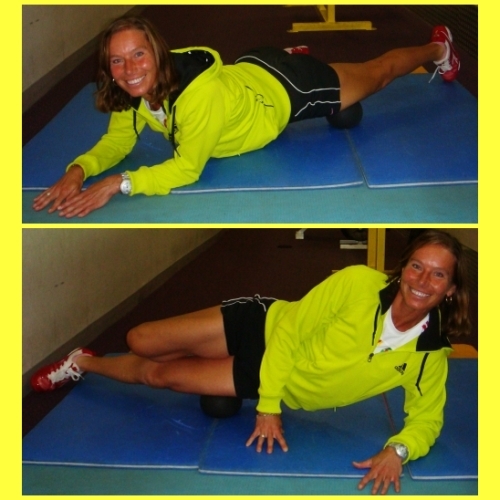
It is very likely that almost every tennis player will experience knee pain at one point in their career. Playing tennis on the hard courts (the only courts in Los Angeles) is tough on the joints and surrounding muscles. The overuse of the quadriceps muscles result in build up of trigger points – extremely painful spots anywhere in your muscles. The trigger points often refer pain to other areas in the body. One common place of tightness and trigger points is the illiotibial band (IT band) – a connective tissue that runs along the outside of the thigh from the hip to the knee, and often causes pain on the outside of the knee. Any lateral movement can be excruciating. This painful condition is called illiotibial band syndrome. There are many factors that can contribute: poor flexibility in the hips, tights, and calves, strength imbalances in the body, incorrect movement mechanics, poor shoes or overtraining. Stretching the IT band helps, but it is not very easy stretch to perform.
Ouch, knee pain – tendinitis, damaged meniscus cartilage, bursitis, damaged ligaments or arthritis of the knee… Even Rafael Nadal knows how extremely debilitating a knee pain can be. Every step you take, there’s an irritating pain. Your movement is inhibited and your hopes for a good match are fading away. The steady improvement that you strive for in tennis seems to be on hold, as long as your knee pain is bothering you. It is unimaginably easy to get rid of your knee pain, if you understand what is going on. Unless you tore a ligament or something similarly bad, most of the knee pain is nothing more serious than referred pain from trigger points in the quadriceps muscle.
Trigger points are small, extremely painful spots in your muscles. If you push on such spot, you feel agonizing pain and you want to pull away. Trigger points can develop as a result of muscular injuries or trauma, improper body mechanics or structural imbalances, poor nutrition, lack of sleep, stress, overtraining, and more. Trigger points inhibit proper function of the muscle fibers and therefore create more problems. Generally, once the trigger point is created, it doesn’t want to relax on its own and it needs to be helped.
Trigger points can exist in the muscle bellies or tendons that attach to the bone. Often trigger points create a referred pain (pain that is somewhere else than the trigger point itself). For example you push on a trigger point in your hip and you might feel pain in your knee. The level of pain depends on the level of irritability of the trigger point. Sometimes a trigger point in the tiniest muscle can cause the most extreme pain. Even tension headaches, migraines or stiff neck can be expression of referred pain. Lot of chronic injuries are caused by trigger points. As doctor Robert D. Gerwin, MD states:
“Doctors who specialize in pain treatment suggest that trigger point, small contraction knots in the muscles of the body, are the primary cause for about 75% of chronic pain cases. They further report finding trigger points in virtually every patient they treat.”
It is very difficult to diagnose and treat trigger points, as they often refer pain to other parts of the body. Therefore it is very important for you to be in touch with your body by always looking for trigger points and release them before they can create more future problems. Especially if you are having issues with chronic injuries, you have to learn how to treat yourself.
How to Release a Trigger Point
- Massage the spot with deep, short, repeated strokes, in the same direction.
- You should be working on pain level of 7 on a scale from 1 to 10.
- Work each trigger point 6-12 times par day, with 6-12 strokes per trigger point.
- If you don’t feel much relief, you might be rubbing the wrong spot.
Read more articles about trigger points and myofascial release and what tools to use, or get your own myofascial release e-book with all the important myofascial release exercises and techniques, and play injury free forever.
.